
A Little Relief on the Jobsite: How Next-Generation Robots Are Changing the Hardest Work in Construction
How a new generation of construction robots is improving safety, productivity, and the way work gets done on projects big and small.
Published in partnership with CSC Robotic.
Authors: Erin Khan and Sandra Grigoletti
Robots are beginning to change the way construction work gets done, but most have yet to reach the average jobsite, where the bulk of construction actually happens. Data centers and skyscrapers may grab headlines, but if robots only serve marquee projects, they will never truly transform the industry. Giving robots “sight” allows them to adapt to any project and deliver the productivity gains construction desperately needs.
From String Lines to Layout Robots
To understand where construction robotics may be headed, it helps to reflect for a moment on how far the industry has already come.
For centuries, construction layout relied on simple but effective tools: strings, stakes, a reliable plumb bob, tape measures, and geometry. While this traditional approach still works and remains in use today, it requires significant skill, time, and manual effort, resources that are increasingly scarce in today’s labor market.
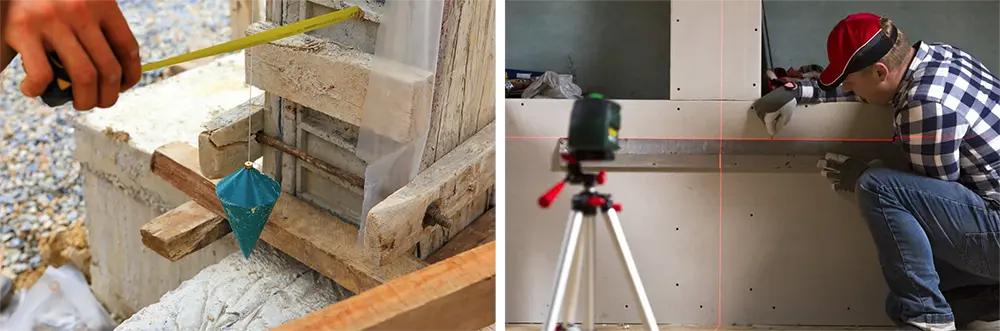
Left: Traditional layout tools, Right: Robotic total station for digital layout (source).
The introduction of the robotic total station was a major shift in the traditional layout process. By connecting digital models to physical space, total stations allowed crews to locate exact coordinates quickly and with high precision. In many ways, it became the first widely adopted robot on construction sites. However, it still introduced challenges in maintaining consistency across multiple trades using different layout methods. Robotic total stations offer extremely precise measurements, yet layout-related rework still occurs regularly on jobsites.
The next step, where the industry is today, was the emergence of BIM printing robots. Systems such as Dusty Robotics, HP SitePrint, and Rugged Robotics print layouts directly onto the floor at full scale, putting the work of VDC teams directly in front of the tradespeople when and where they need it. This allows trades to access the digital model directly in the field, making BIM printing robots the next major robotic technology to gain traction on jobsites.
Robots Tackling Drilling
The next generation of machines is meant to not just accomplish layout, but automate the work itself, starting with tasks like concrete drilling.
Across nearly every type of construction project - from hospitals to data centers - crews must drill thousands of holes for anchors, seismic bracing, and structural connections. Over time, that repetitive strain takes a serious, often irreversible toll on workers. In some trades, workers develop permanent injury in their hands after years of exposure to vibration and constant pressure from power tools.
The work gets done, but it often comes at a physical and monetary cost. This is why anchor drilling is one of the classic “dull, dirty, and dangerous” tasks now being targeted by robotic solutions.
Among the drilling robots currently entering the market, two primary approaches have emerged. The first generation of work-performing robots relies heavily on extensive BIM preparation and robotic total stations. A newer class of robots is beginning to rely on machine vision, giving robots the ability to “see” the jobsite rather than relying solely on digital models. These systems are also enabling multi-robot workflows.
The convergence of BIM printing robots and AI vision-enabled machines creates an opportunity for truly collaborative environments where humans and robots work side by side. This kind of workflow could finally bring construction closer to the levels of automation that most other industries have achieved over the past forty years.
The Origin of CSC Robotic
CSC Robotic was founded in 2019 after emerging from an incubation initiative within a major MEP contractor in Hong Kong. The company’s origin story begins with a problem many workers know all too well: overhead drilling.
Holding a heavy drill in an awkward position above your head while boring into concrete is one of the most physically taxing tasks on a jobsite. For workers performing the task hundreds of times a day, fatigue quickly becomes a reality.
Their first robot, introduced in 2020, was designed specifically to address that challenge. Mounted on a scissor lift, the machine automated both overhead drilling and anchor installation, while delivering consistent accuracy.
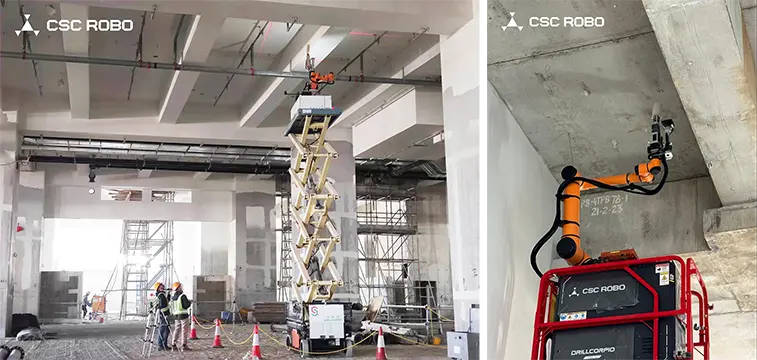
Left: Drillcorpio (Model D2), Right: Drillcorpio (Model D3)
In 2025 CSC Robotic made its global debut, adding an autonomously navigating, omni-directional drilling robot, Drillcorpio DF as well as a welding robot, Weldcorpio.Using technologies such as LiDAR, AI Vision, and SLAM (Simultaneous Localization and Mapping), these machines can also understand their position within complex environments and move through jobsites in ways that were previously impossible.
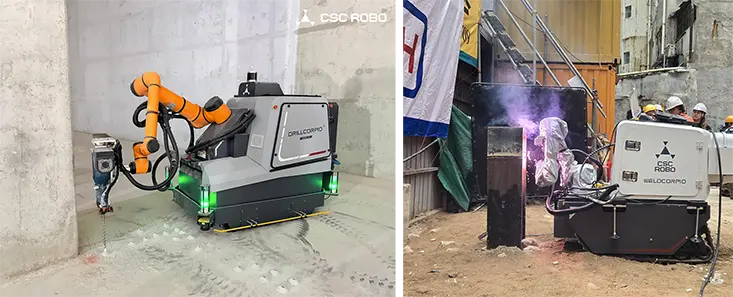
Left: Drillcorpio (Model Df), Right: Weldcorpio
Rather than being fixed to a single point, robots can now navigate spaces, locate tasks, and execute operations repeatedly with consistent precision.
CSC Robotic’s U.S Sales Director, Sandra Grigoletti, describes the process simply: you “take the robot for a walk.”
A worker places the robot in a work zone, and once positioned, it can autonomously move from location to location completing tasks, much like a skilled apprentice moving through the jobsite.
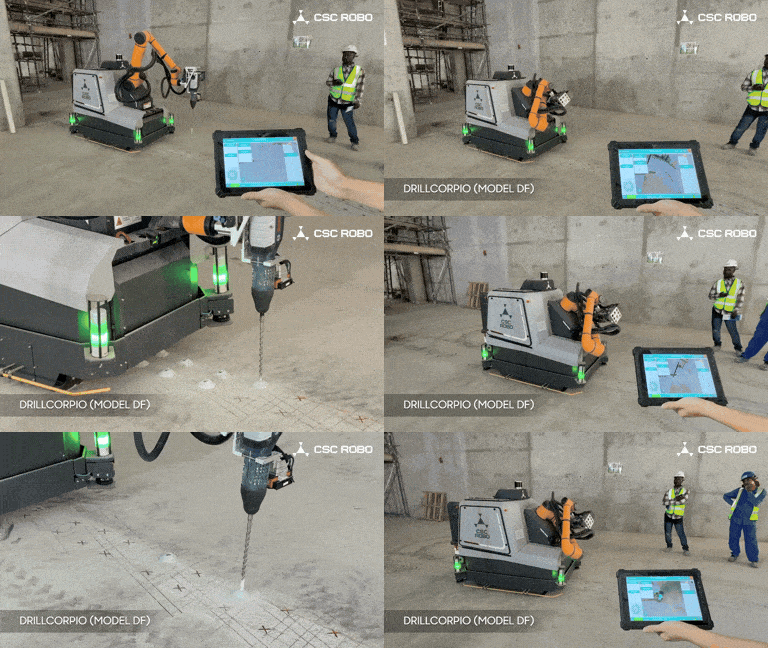 Drillcorpio (Model Df)
Teaching Robots to “See” the Jobsite
CSC’s system approaches automation differently from many existing construction robots.
Most construction robots depend on highly detailed BIM models to operate. Every anchor point needs to be precisely modeled before work can begin. Anchoring components for MEP systems often represent less than 20 percent of installed elements but nearly 40 percent of modeling time. Updating those models every time conditions change can become a major bottleneck. There are also many drilling applications, such as rebar doweling, where modeling every individual point is not an effective use of limited digital resources.
When robots rely entirely on detailed digital models, they can only operate on a small fraction of jobsites. This reality locks many drilling robots out of the majority of construction projects, despite contractors overwhelmingly identifying drilling as a task worth automating.
**If robotics are to make a significant impact on productivity and safety, they need to work on typical job sites, not just highly digitized flagship projects. **
CSC’s robots instead rely on visual AI and spatial mapping to interpret the environment around it. Using cameras, sensors, and SLAM navigation, the robot can understand the physical space, identify work locations, and drill to a simple mark on the ground.
This allows it to:
• Work from the same marks humans use - whether a simple Sharpie X, a laser projection, or a printed BIM object
• When digital models are available, autonomously navigate to work locations
• Capture as-built information automatically during drilling operations
In essence, the robot is learning to see the jobsite in a way that mirrors how human workers understand their surroundings.
Real-World Jobsite Applications
The applications for robotic drilling extend far beyond experimental projects.
Common use cases include:
• MEP installations, where thousands of anchors must be drilled overhead
• Rebar doweling, connecting new concrete to existing structures
• Seismic bracing installations
• Data center construction, which often requires extremely consistent anchor placement
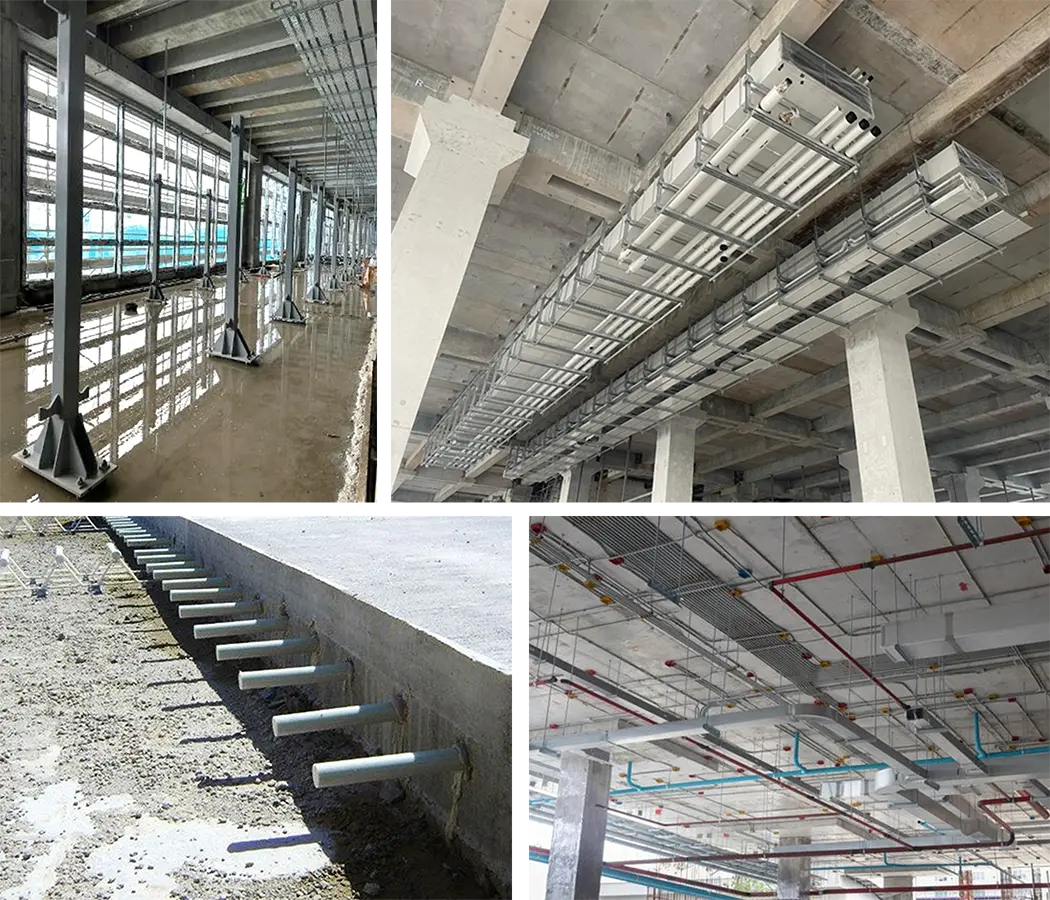
In infrastructure projects, the scale can become even more striking. In the Hong Kong’s T2 Trunk Road project, CSC’s both drilled and installed over 17,000 wedge anchors for MEP systems.
One of the first Drillcorpio Df systems set to deploy into the US is drilling more than 20,000 holes for aeration piping installations - work that would be extremely demanding for human crews but well suited for robotic automation.
Depending on factors such as hole size, depth, density, and concrete hardness, CSC Robotic reports productivity improvements of 20–30 percent compared to manual drilling.
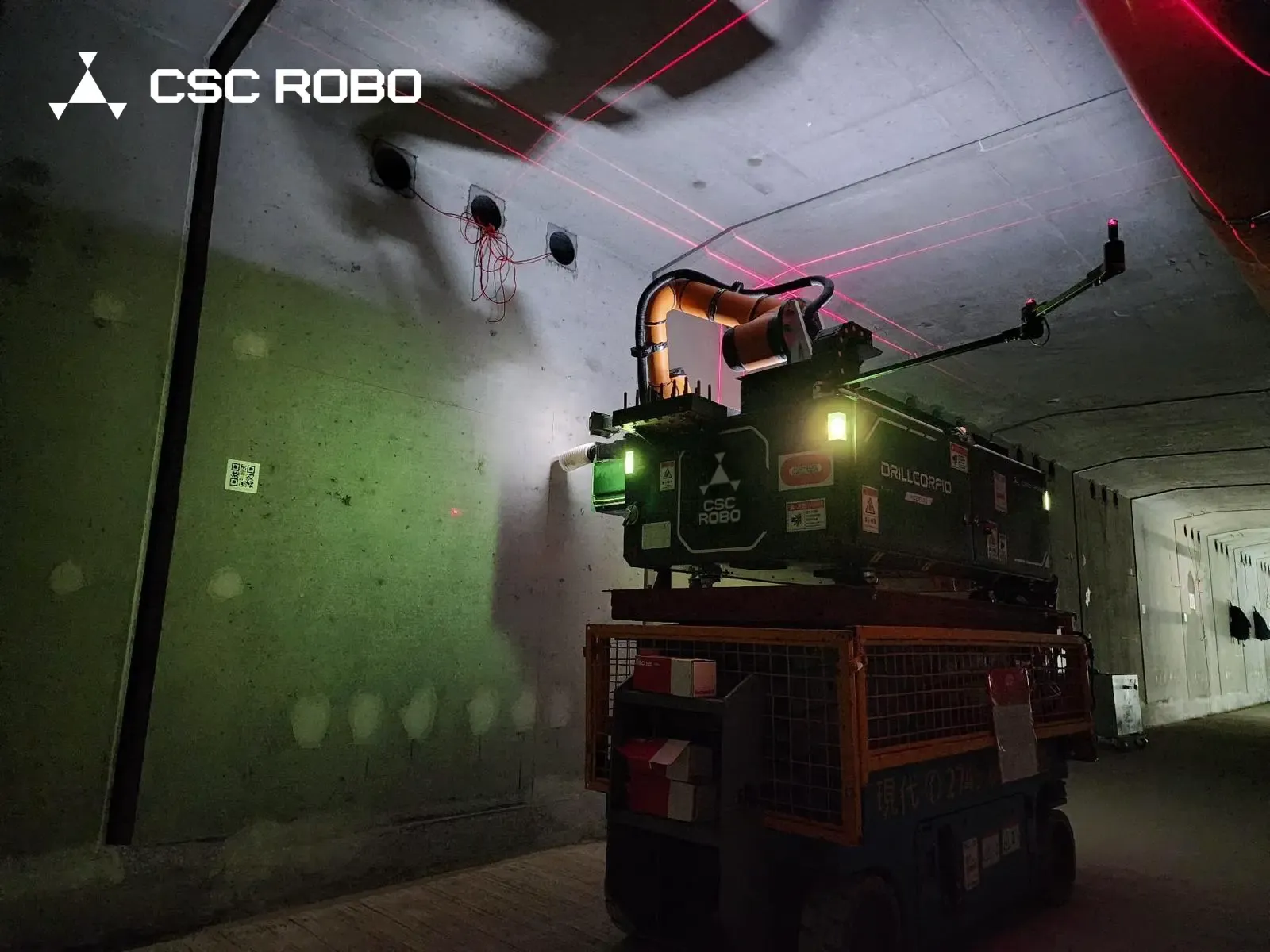
"The innovative drilling robot developed for assisting MiMEP installation has significantly improved efficiency. It shortened the construction timeline from six months to four months and reduced labor requirements from five workers to just one. Thank you for your full support, which enabled us to achieve our project goals ahead of schedule."
Project Manager,
Dragages Hong Kong Limited
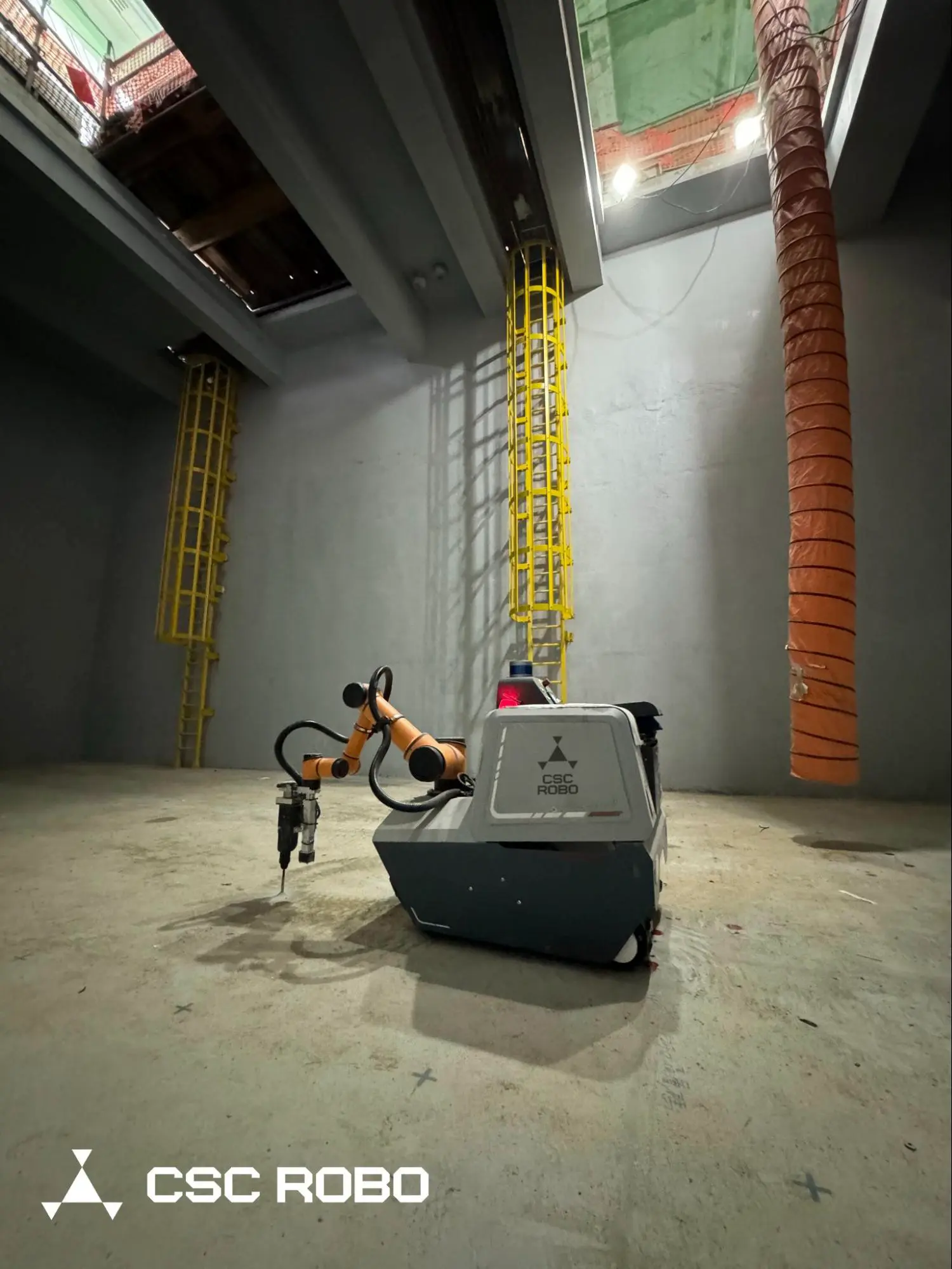
“Drillcorpio (Model Df) has demonstrated outstanding capabilities in precision drilling and efficiency. This robot not only improved our productivity in our Effluent Polishing Plant Project but also ensured greater safety for our team members on-site.
Thank you for your commitment to advancing construction technology and for providing us with a tool that consistently exceeds our expectations.”
Project Manager,
Jardine Engineering Limited
The Next Evolution of Construction Tools
As many of us know, technology adoption in construction rarely happens overnight. The industry has gradually moved from hand-crank tools to power tools, from corded tools to cordless ones, and from paper drawings to digital models. As robotic machines become more capable of navigating real jobsites and adapting to field conditions, they stop appearing on projects as experimental technology, but instead as another practical tool in the contractor’s toolkit.
AI vision-enabled robotics may simply represent the next step in that progression. As BIM printing continues to become a standard method of communicating layout information in the field, robots like CSC’s Drillcorp can read those markings the same way their human coworkers do.
As vision-driven systems like those being developed by CSC Robotic continue to advance, the industry may move toward workflows where humans and robots operate side by side. This could help the industry address two of its most persistent challenges at once: improving productivity while protecting the workforce that keeps construction moving.
In the end, the goal of construction robotics is not simply automation, it is building better projects while protecting the people who build them.
Interested in learning more? Contact Sandra Grigoletti at: sandragrigoletti@cscrobotic.com and check out CSC Robotic’s Website and LinkedIn page.