
Built on Instinct, Buried in Data: Why Construction Requires Connection
What if the industry's biggest problem can be transformed into its best solution?

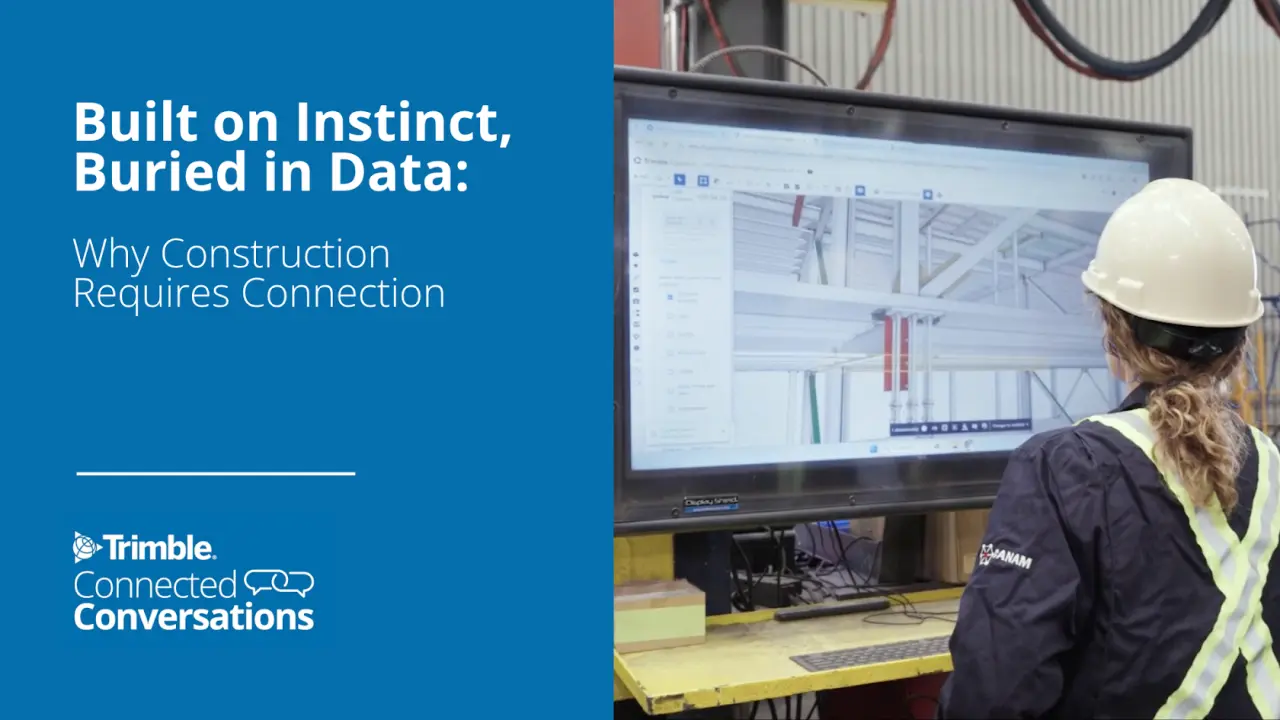
How connected data is turning one of construction's oldest problems into its clearest opportunity.
Published via paid partnership with Trimble Inc..
What if the industry's biggest problem can be transformed into its best solution?
In my work across the industry, I often see a problematic pattern: builders are using data more than ever before, but somehow still find themselves frustrated when more information doesn't magically solve on-site challenges. What's missing from this equation isn't just more or better data – it's connection.
Data only improves operations if it reaches the people who need it, at the right place and at the right time, to prevent and solve problems meaningfully. In this piece, I want to highlight what goes right, in very human terms, when data is truly connected to the people who design and build our world.
Canam, an expert North American Steel manufacturer, exemplifies the power of connected data in their operations. One recent example comes to mind: a Canam Steel crew was deep into a high-rise project in downtown Toronto when the concrete work started to drift out of tolerance. On a disconnected job, that kind of deviation shows up as a surprise; a piece arrives, doesn't fit, and the crew loses hours reworking it on-site, at height, on the clock. However, because Canam's field data was connected back to the shop in real time, the team caught the shift weeks before it impacted the job site, and successfully adjusted the fabrication specs for pieces still on the line.
Nobody worked harder because of that deviation. They just knew about it sooner, empowering the team to prevent rework, mitigate safety risks, and eliminate project delays.
That's the power of connected data: creating an industry that is predictable, safe, and brings the people who build together.
Data Is Your Most Underutilized Asset
Construction is one of the most data-intensive industries in the world, where every job generates drawings, specs, schedules, and field conditions by the thousands. Yet for decades, builders have sat on this data goldmine, treating it as a paperweight: information is generated, filed, and left alone until someone needs it and can't find it.
The data goldmine is only unlocked when it's connected from design to fabrication to the field, in real time, without someone manually re-keying it at every handoff.
Canam's own operations show what that looks like. With drafting teams spread across North America, Romania, India, and the Philippines, they have operationalized working off a central connected model, passing work around the clock rather than waiting for a single office to open.
This goes beyond just a good technological implementation; because of leadership's strategic investment in connected data as a company asset, Canam can now bring a more proactive and collaborative approach to operations.
The Human Cost of Disconnection
The most expensive part of disconnected data isn't the data gap itself, but what people are forced to do to compensate for it.
A 2024 survey of contractors by Dodge Construction Network across the U.S. and Canada found that 98% had experienced serious quality issues such as errors, omissions, and rework on a project in just the last three years. Much of it traces back to a simple gap: only 11% of field personnel said they always have access to the information they need about what and where to build. Additionally, coordination issues alone were found to erode profit margins by an average of 10% a year
Ask anyone who's worked a night shift on a shop floor. Before connected data, a missing dimension on a drawing meant a piece sat idle until a drafter could be reached – sometimes 20 minutes, sometimes until the next shift entirely. Multiply that across a crew, and those minutes become a quiet tax: skilled people spend their time chasing information instead of doing the work they were trained for
Data that everyone can reach closes that gap before it costs anyone a shift
The Hidden Solution
Connected data isn't a flashy fix – it quietly sits in the background of operations as a hidden data infrastructure layer. However, its impact is undeniable. At Canam, it's reshaping how thousands of people do their jobs every day.
Trimble Connect functions as what one Canam project coordinator calls a single point of truth: instead of calling around and waiting for whoever "owns" a piece of information, that information becomes available to whoever needs it, the moment they need it. That shift is realized at scale, with Canam running Trimble Connect across more than 1,000 users spanning plants and offices worldwide.
It shows up in smaller, human moments too. Philippe Lebel, who works in geospatial and metallurgy technologies at Canam, was once the only person who could interpret his own 3D scans, becoming a bottleneck by necessity. Trimble Connect alleviated that by democratizing the data itself: once the data lived in a shared model, anyone on the team could pull the answer directly, eliminating him as the single point of access for key project information.
"You don't want to be the bottleneck of the process — you see it expand beyond what you would have been able to do by yourself."
— Philippe Lebel, Innovation, Geospatial & Metallurgy Technologies, Canam Group
That same benefit shows up with customers, too. One customer, introduced to Trimble Connect's issue-tracking tools by a Canam project manager, liked it enough to request it on every subsequent project.
What Leaders Can Do Now
(1) Decide that data is a strategic asset. Canam's Lévis plant modernization is the clearest proof point: after investing in connected tools and processes, the plant saw an 82% efficiency gain in eighteen months. That kind of return comes from leadership treating data infrastructure as a priority worth funding, not a software line item.
"We saw an improvement of 82% in efficiency — we increased, in 18 months, 82% into efficiency."
— Gino Bernier, General Manager, Lévis Plant, Canam Group
(2) Include the field from day one. The most valuable connected data isn't generated in the office; it's generated on-site, in the shop, on the night shift. Leaders who build two-way pipelines between the field and the model get an early-warning system for problems that used to show up as expensive surprises.
(3) Choose technology partners, not just tools. Canam's willingness to pilot new technology – from 3D scanning to smart glasses to total stations – happened because they had a partner in Trimble, willing to build alongside them. As one plant manager put it, if you wait for a tool to be perfectly proven before you try it, you're already behind.
Conclusion
What changes when data is connected isn't the industry itself, but rather where people's effort goes. When data flows the way people do – from the field to the shop, from one shift to the next, from one country's drafting team to another's – people spend less time compensating for disconnection and more time doing the work they're actually good at.
That's already visible on Canam's shop floors, where plant leaders are exploring robotics and automation for repetitive fabrication work; not to replace the people who've built this industry, but to hand them better tools than a tape measure and a hunch.
In short, construction has an incredible opportunity to transform by utilizing an asset it already has: data. By connecting that data to everyone who builds – in the shop, in the field, in design – we can give our people a better way to build.
Sources:
Dodge Construction Network. Not By Design: The True Cost of Poor Collaboration in Construction (2024). https://www.construction.com/resource/not-by-design-the-true-cost-of-poor-collaboration/
Trimble. Connected Conversations: Episode 1 — Canam (2026). https://www.youtube.com/watch?v=07hUcw_NuAs